Showing posts with label Soup. Show all posts

May 11, 2016

Zucchini & Corn Soup

May 11, 2016
SproutsZucchini Corn Soup
Is a blind uncle better than no uncle, I wonder, while dropping you a recipe without any other content?


Zucchini & Corn Soup
(Serves 2-4 persons)

Ingredients:
2 small zucchinis (about 400g)
1-2 Tbsp ghee, butter or oil
1/4 tsp hing powder
1 tsp coarsely ground black pepper
1/4 tsp sweet paprika powder
3/4 tsp dry dill
1 cm (1/3”) fresh turmeric root, peeled and finely grated
750 ml (3 Cups) water
400 ml (1 1/2 Cup) frozen corn
125 ml (1/2 Cup) Greek style thick yogurt
1 tsp salt
1 tsp kala namak powder
125 ml (1/2 Cup) fresh dill

Method:
Wash, peel and cut the zucchini in half lenghtwise. Slice the halves into bite-size pieces crosswise.

Heat up the ghee in a pot. Add the spices and then the zucchini slices. Sauté the vegetables for a few minutes. Add the water. Cook, covered, until the zucchini pieces are tender but still firm. You don’t want them to become mushy!

Add the corn kernels. Bring the liquid to a boil and mix in the yogurt. Remove the soup from the stove and toss in the salt and kala namak powder, and the fresh dill.

Optional:
Garnish with sprouts.


April 13, 2016

Broth & Daikon Noodles

April 13, 2016
Let me push the mop aside and get up from my knees to tell you what has kept me from updating the blog.

I’ve come to think of our cottage as a lovely granny, who squeaks, leaks, and lapses. Like any 91 year old, she urges constant care. Although I nurse her, she’s prone to accidents and regularly falls apart. She is cozy, but also naughty, and it’s a full time job to tend her. Her mishaps keep me busy and make my life unpredictable.

For example, I was cleaning the woodstove in the kitchen a week ago. Suddenly carbon deposits blocked the ash vacuum, blowing the soot around the house. Goodbye white walls, ceilings and floors! And, good bye a new blog post! Since then I’ve been scrubbing every surface, furniture, and household item, and washing the textiles. By now, I’m only halfway through.
1-Daikon-noodle-soup2-Daikon-noodle-soup
Before I'll climb on the ladder to sweep the walls, let me drop you a recipe I came up with in March while fasting on a festival day. Although I didn’t entertain my mind with anything fancier than a warm, clear broth while abstaining from food, I added spices, herbs, and vegetables to the soup when I cooked it later. Protein, like chickpeas or kidney beans, would make it more filling. Tofu or paneer would go very well with it, too.
3-Daikon-noodle-soup4-Daikon-noodle-soup
BROTH WITH DAIKON NOODLES
(Serves 2-4 persons)


The broth:
2 Tbsp ghee or oil
2 ½ cm (1”) cinnamon stick
5 cloves 2 star anise
1 tej patta
1 tsp fennel seeds
½ tsp jeera seeds
¼ tsp hing powder
1 green chili (hot)
2 ½ cm (1”) ginger
1 l (4 cups) grated vegetables (sweet potatoes, cabbage, potatoes, carrots, kale etc)
2 l (8 cups) water


The eggplant:
1 eggplant
2 Tbsp ghee oil
1 tsp coarsely ground black pepper
2-3 Tbsp Bragg soy sauce


Other ingredients:
7 ½ cm (3”) daikon
3-4 small grill peppers
250 ml (1 cup) broad beans
2 tsp Himalayan salt or to taste
1 tsp kala namak
1 ½ tsp amchoor powder
1 bunch of basil leaves and seedlings


Make the broth first. Heat up the ghee or oil in a pot. Add the cinnamon, cloves, anise, tej patta, fennel and jeera seeds, and fry them for 30 seconds. Sprinkle in the hing powder, and add immediately the chili and ginger. Fry the spices, tossing, for 30 seconds before adding the vegetables. Sauté the vegetables for a couple of minutes then pour in the water. Cover the pot and bring the water to boil. Then reduce the heat to moderately low and cook for 40 to 60 minutes.

Strain the liquid and keep it warm until all the components are ready. Save the vegetable fiber for pancakes or bread.

While the broth is cooking, dice the eggplant. Heat up the ghee on a frying pan. When it’s hot, add the black pepper. Toss once and add the eggplant pieces. Fry them over moderate heat until they are golden on all sides. Pour in the soy sauce. Place the eggplants into the broth. Spiralize the daikon into long noodles and cut the peppers into thin slices. Place them and the beans, along with the salt, kala namak and amchoor into the broth. Garnish with basil leaves and seedlings.

Alternatively, you can place the vegetables, basil leaves and seedlings on individual plates and pour the hot broth on the top of them.

Thank you.


October 5, 2015

Winter Squash Soup

October 5, 2015
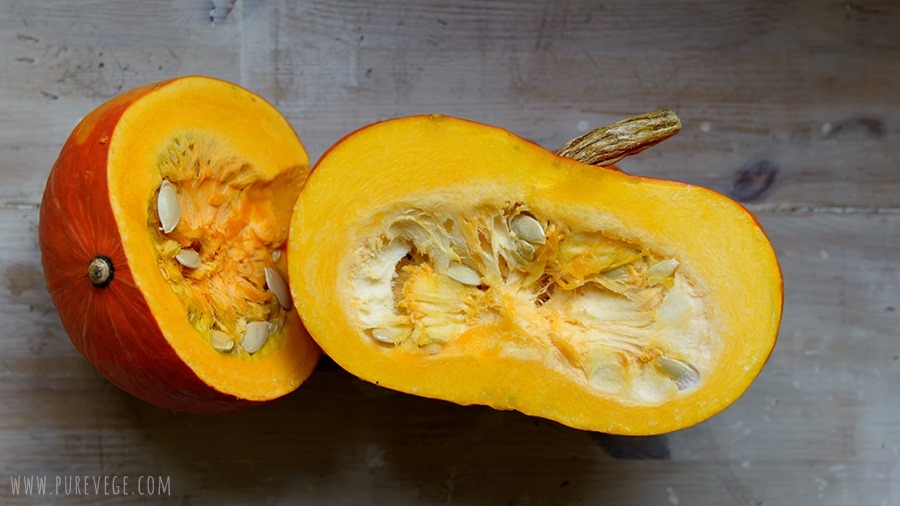
5-Winter-squash
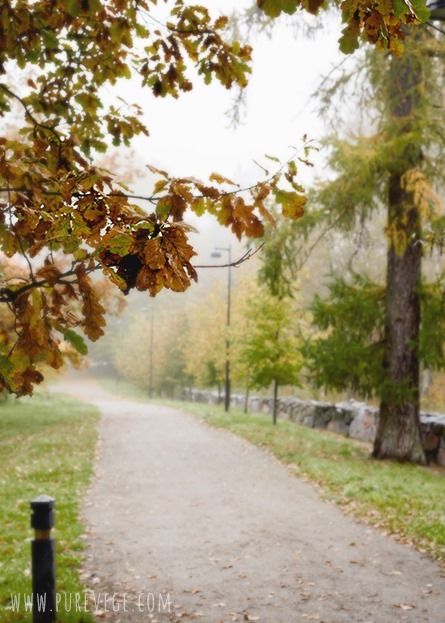
Four months ago, when dahlias and asters were crowning the summer season, I inserted a mesh on the windows to bar insects from entering, and to hear the swish of an oak tree that quivers on the backyard like a parasol. Under the canopy you’ll find clusters of acorn – little nuts that look like heads wearing a cap or, as I like to imagine, bells that jingle in the evenings when the man-made world – far away – quiets down. Although woodland creatures – deer, squirrels and birds – gobble them like a starving tribe, I’m sure it is the humming of these wind-chimes that lulls us to sleep every night.
6-Autumn7-Autumn
Like adulthood, summer induces the best of many. It stands for potential, and ushers us to wander and explore. Time expands to ripen everything that started earlier as a seed: red currants, wheat, families, and our hopes and needs. With more ease and comfort than in youth, our self-acceptance matures like a corncob in the field.

But, usually sooner than we’d like, shadows grow taller and the breeze hints at the change of mood. Blooms retreat and greens fade. Then, one morning, chirping becomes but a heavy sigh. That’s when you have to pull down the screens and install the windows back. Hey mosquitoes, bees and flies! Where are you now? Have you escaped to a warmer sphere because the autumn is here?

1-Winter-squash
Leaves fall from a tree when they lose their grasp. They hover down and transform. Such falling has indicated autumn (in English) since the early 1600s. Before that, the season was called a harvest.

‘Harvest’ sounds so much more abundant than ‘fall’, doesn’t it?

Although labor-intensive, it reminds of togetherness, woolen socks, hot chocolate, and thanks-giving. It’s the time to reap our quota, gather crops, preserve energy, extract from the culture, wind down, retire to an inner space, and stack for the winter (or the old age). Falling, which is an urban term, signals that something or someone is becoming less, diminishing and sinking inward, failing to keep up or meet expectations, and descending or collapsing by a force, such as gravity. Many have fallen from grace. Which of us hasn’t fallen apart at times?
8-Autumn
Autumn is one the scenes nature lays out to teach. As a constant, it walks us through a series of changes, year after year, to show decomposition and the end of all, and then, a renewal. Past the prime, at fifty, I can relate to this better than ever. The seasonal cycle offers a program for a slow-learner like me to reflect on the wheel of samsara, repeated birth and death, and the duties that come along with participating in such a pastime.
3-Winter-squash
To undergo a change is rarely easy – especially when it defies my identity, relationships, abilities or means. When a challenge becomes too overbearing, I take shelter of routines or my personal invariables that anchor me to the favorable side of the situation. Sanguinity works as an inherent antidepressant and enables discernment that clears doubts. Such keenness of insight is an essential element of meditative outlook. It activates the brain’s reward center in a sustainable manner. A conscious effort to recognize positive and negative emotions by describing them in words boosts serotonin and dopamine, the feel good hormones that reduce stress. A constructive disposition of the mind – acquiring knowledge, and feeling grateful and humble – produces good impressions which, in turn, develop into a good habit that will gradually expand awareness. To solve problems by employing guilt, shame, anger and anxiety, on the other hand, gives a quick release, but will propel to destructive impulses again in the future.

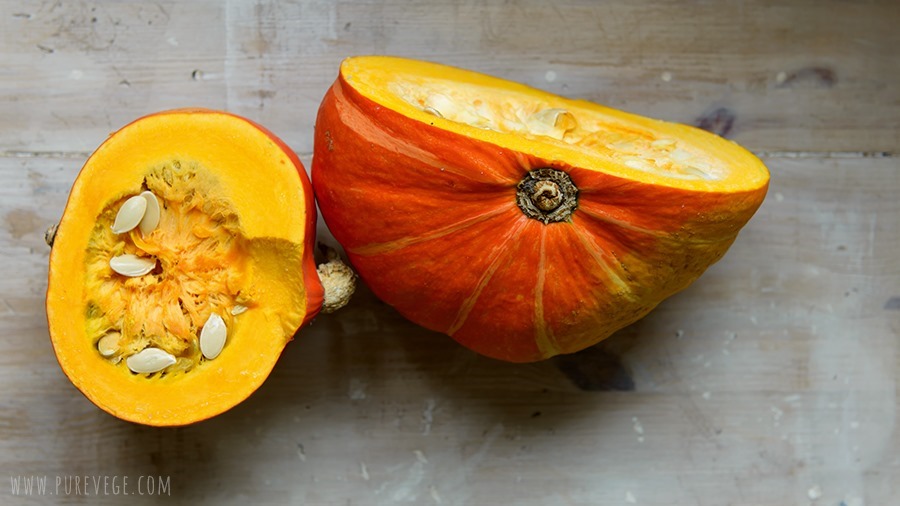
Pumpkin soup is one on my autumnal balance points. This must be the third pumpkin soup recipe on the blog; not because I’m addicted to the gourd family fruits or consider them more noteworthy than other vegetables, but I jump at them on the market because they represent the bright face of autumn. Under their skin beats a soft, generous heart – the kind I’d like to cultivate, too.

2-Winter-squash
In what ways is the autumn tutoring and empowering you?
4-Winter-squash
WINTER SQUASH SOUP


Ingredients for the soup:
2 Tbsp ghee (or butter, or oil)
¼ tsp pure hing powder
1 Tbsp grated fresh ginger
1 tsp grated fresh turmeric
2 medium size potatoes, diced
4 cups (1 liter) diced winter squash
¼ - ½ tsp cayenne powder
4 cups (1 liter) water
2 tsp dry roasted panch phoron powder
2 cups (500 ml) whey
2-3 tsp Himalayan salt
½ - 1 tsp garam masala powder


Ingredients for the garnish:
1 Tbsp ghee (or butter, or oil)
2 cups (500 ml) diced Hokkaido squash (red kuri)
2 pinches of Himalayan salt
1 pinch of cayenne powder
Roasted pumpkin seeds
1 -2 cups (250-500 ml) shalloew-fried paneer cubes


Cooking method:
Heat up the ghee (or butter, or oil) in a large pot. When it’s hot but not smoking; sprinkle in the hing powder, and grated ginger and turmeric. After about a minute, add the potato dices. Fry the potatoes over moderate heat, stirring occasionally, for about 5 minutes. Then toss in the winter squash dices and continue frying for another 5 minutes before pouring in the water. Cook (covered) until the vegetables are soft. Use a food processor, a stand blender or a hand blender to break the vegetables into a velvety soup. Whisk in the panch phoron powder, whey and salt. Bring the soup to a boil again, reduce the heat and simmer for about 5 minutes. Finally add the garam masala powder before serving.

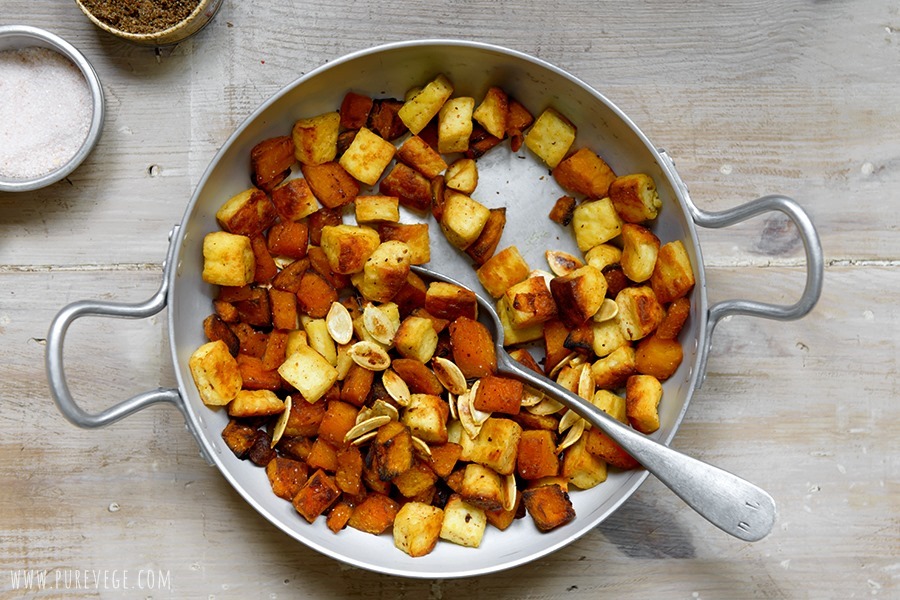
While the soup is cooking, heat up a tablespoon of ghee (or butter, or oil) in a wok or a pan. Add the Hokkaido squash dices and sprinkle them with salt and cayenne. Fry them until they are cooked, stirring occasionally. Add the roasted seeds and fried paneer cubes. Combine the garnish with the soup.

A tip:
For panch phoron powder, take equal amount of each: mustard, fennel, jeera, kalonji and fenugreek seeds. Dry roast them on a pan over a moderately low heat until the seeds are a few shades darker and aromatic, for about 5 minutes. Let the spices cool down and grind them into powder.

The simplest garam masala powder consists of toasted cinnamon stick, cardamom seeds and cloves. You may add black peppercorns, jeera, fennel, coriander, tejpatta, nutmeg and other spices to make it more complex.

Thank you.


October 15, 2013

Forest Lunch

October 15, 2013
63
K-PAX was a film screened in 2001, starring Kevin Spacey, about a psychiatric patient, Robert Porter, who claimed to be from a planet K-PAX. While being treated for delusions in the Psychiatric Institute of Manhattan, he quickly became the leader of other patients who, without exception, found his extra-terrestrial background believable and inspirational. In fact, even the doctor who analysed him, Dr. Mark Powell, was at times baffled by his proficiency in astronomy, physics and advanced psychology. In spite of the doctor – patient relationship, he took seriously Robert’s advice to evolve and reconciled with his estranged son. After all, according to a “k-paxian” report, our universe is known for repeating its mistakes again and again, forever.
78
Whether the film was a sincere portrayal of the grey area between a mental illness and unknown, supernatural aspiration, is irrelevant here. I’m mentioning it because my today’s recipe is called “K-PAX soup”! My beloved bhakti-yoga mentor – my Gurudev – gave it to me years before I knew about the film. It was his favourite lunch item for awhile. He passed away in 2006 and I never had a chance to ask why he named the soup as such. He was an eccentric personality with an exceptional intelligence and a quirky sense of humour. I suspect the name was related to the origin of the recipe: a person he might’ve jokingly likened to a “k-paxian”.
59
In the secular society it’s acceptable to designate oneself according to the family line and relationships, race, gender, income status, education, occupation, moral, religious or political standing, and talent etc. We usually bypass quickly the question “who are you?” by offering our name and field of work. Everyone has a shortcut to pin oneself in a position one wants to be associated with and, if the situation allows, we are thrilled to narrate the longer version of our achievements and personality traits.

From the point of view of spiritual reality all such distinctions are, however, alien identities even though they may be within commonly admissible behavioral boundaries. Vedanta-sutra, the essence of knowledge compiled by Srila Vyasadev thousands of years ago, starts by an aphorism athato brahma jijnansa: the human form of life is meant for inquiring about the spiritual nature; the substance of all forms and definitions. To someone freed from physical, mental and intellectual coverings, we likely look as “k-paxian” with our illusory selfhood as the poor Robert Porter in the film.
12
Whatever the case, this soup is very good! There are only a few, selected spices that compliment each others. It depends on the complexity of the curry powder how much taste it attributes. I’m using a home-made mixture of roasted coriander, mustard, fenugreek, jeera, urad dal, black peppercorn, red chili, curry leaves and turmeric, but you can substitute it with a simple a combination of (roasted) jeera, fennel, coriander, red chili and turmeric. Or, use a store bought curry powder.

The soup is best served with bread or a piece of pie. We had an eggplant tart on our forest lunch.


March 3, 2013

Back to The Basics

March 3, 2013
It’s the time of the year in the Northern hemisphere when the sun reveals how dirty the windows are and how much dust has collected above and below the eye level. This week, I have been brushing, mopping, washing, recycling and throwing away sacks of rubbish. It’s a good start. However, a conversation with a friend reminded me of something I’ve neglected to sweep: my heart and mind. The former looks like a chimney and the latter is about to explode with unsorted ideas, ambitions and emotions.

I’ve always had an urge to simplify. That’s why I’m drawn to ascetics and sages. They are oblivious to mundane. Their depth of reality, unlocked by the inner eye, remains invisible to those who rush to conquer the world of names. Bare souls, stripped from designations, are often stigmatized as socially plain, simpletons. It doesn’t bother me. On the contrary, I’m intrigued by the sustenance and satisfaction provoked by an apparent lack of amplitude. Is there anything more valuable than freedom and satisfaction experienced by an uncluttered mind? It always seeks to apprehend particles in relation to a whole. Such genius of thought is able to extract the essence of all with a single stroke, without entangling with details and forms. It serves the core of our being and connection to the primordial awareness and values, Divinity.
Dal1Dal2
Although sophistication has a derogatory annotation in the modern language, we are keen to aspire it. Its origin is in Greek sophos, wisdom, which was an ornament of poets and visionaries who reached to verbalize beneficial concepts for others. However, the philosophers of the 5th century BC – sometimes referred to as the hair-splitting wordsmiths – brought the practice down with a thirst for power and deception at the cost of truth. Their willingness to sell an idea for popularity describes accurately the tendency to move outwards, away from the center of perception, and simplicity.

As a network of conditions, arranged by a complex mind, sophistication is loaded with prerequisites, ranks, restrictions, details, theories, proofs and qualifications that all must be met on a social and individual level before there is contentment! Any imbalance in a situation, performance or formula will create a negative setback. For a soul, who is – by au naturel – conscious, knowledgeable and blissful, it’s a trap! In the name of refinement and betterment, it attaches us to the subtleties of form. When appraising externals, there is a chance we will divert from the sincerity of intention and, no longer, see the context.

To me, spring cleaning means to undress and fold away layers and layers of self-appointed identifications I have collected over the winter. Returning to blogging, finally, brings me back to the basics. I would like this year to mark my kitchen meditation as an opportunity for personal reform. Combining ingredients in a palatable manner counts (to me) only to the degree it makes me genuine and decreasingly envious, angry, greedy, lusty, mad and under an illusion of who I am, where I’m heading at, and why.
Dal3Dal6
Today’s recipe of tomato dal stands for simplicity. As the most advantageous yoga food nature has to offer, it has an exceptional nutritional profile. It’s rich in protein, B-vitamins and minerals. Combined with plain rice, it forms the base of a balanced meal.

Technically, dal is not a soup although the consistency is often soupy. It’s rather considered gravy.
Dal5Dal4
Mung beans are the most digestible of the varieties of pulses known, and can be served to children and elderly alike. Hulled and split, they provide a neutral canvas for spices. A little bit of ginger, chili, cumin, coriander and hing fried in a spoonful of ghee quickly paints an exciting lunch or dinner. There is no limit to the intricacy of flavors that can be pulled out by adding cinnamon, cloves, cardamom, fennel, anise, fenugreek, kalonji or mustard seeds…
Dal9Dal7
However, more important than the altitude of aromas is the consciousness by which the food is prepared, served and enjoyed. It brings us back to the realm of purpose that supports our relationships in this world, and beyond.

Food cooked for the well-being and pleasure of others will generate happiness. The depth and intensity of it translates to our ability to love. When it barely reaches beyond our own needs, it’s meager and miserly. When it transcends the physical laws of nature, and touches the soul of all souls, everyone will benefit.
Dal8Dal8a
Thank you.

July 3, 2012

Summer Soup (Kesäkeitto)

July 3, 2012
1soup2soup
There are dishes of collective emotional attachment in every culture. Summer soup or kesäkeitto, as it is called in Finnish, is such. In the country where a summer season is far too short and offers barely a crop a year, every bite of local harvest is honoured. When the first baby potatoes reach farmers market, people rush to buy them, even, if they cost 16 € per kilo! There is something primeval about cooking and eating native produce.
3soup4soup
In order to appreciate Finnish cuisine, which is plain and modest, one should challenge to live here, at least, through a winter. After nine dark months of vacuum packed and gassed greenhouse fruits and vegetables flown unripe from Spain and Italy, a humble potato with a pinch of salt, dab of butter and a stalk of dill will taste like a gourmet delight.
5soup6soup
The basic summer soup is made of vegetables, milk, butter, salt and dill. If I remember correctly, my grandmother used allspice, too. She would unfold a clean linen cloth onto a table in the shadow corner of the patio, set the plates, spoons and glasses, and carry outside a serving bowl of soup, fresh rye-bread, butter and lemonade. I can still hear our lunchtime conversation mixed with the purling of a small fountain, rustling of garden plants and chirping of birds.
7soup8soup
Another unbeatable bonus about Finnish summer is wild berries. Strawberries come first, then blueberries, cranberries, raspberries and cloudberries.
9soup10soup
These wild strawberries were picked from a gentle forest hill behind our home. Nothing more than sweet whipped cream is needed for a perfect dessert.
11soup12soup
Sophistication is compensated by quality in simple cooking. If the ingredients are first class and treated with proper care and skill, the experience will be satisfactory. Attention to detail always increases value. It also gives a personal touch.
13soup14soup
Happy summer!

February 17, 2012

Beetroot Soup & Little Pies

February 17, 2012
Awhile ago my husband, who doesn’t usually care for soups, fell sick with flu. He lost his ferocious appetite and for days desired only soups. It gave me a rare opportunity to experiment in the kitchen. This beetroot soup is one of the better ones I came up with. And, oh, it goes so well with lovely broccoli and cheese pies.

We eat beetroots often. They are colourful and fun vegetables. I rarely boil them, but usually roast them in the oven or on a frying pan. Roasting condenses the texture and intensifies the sweetness by lending a toffee-like edge. Boiled beetroots taste rounder and milder.

I’ve made the soup twice with the same ingredients but different methods. First time I roasted raw beetroots, potatoes and spices in the oven and added sundried tomatoes to the liquid (whey) with them. The taste was perfectly sweet and sour, and there was something to chew, too.

The second time I fried raw potatoes and spices on a pan, and added sundried tomatoes and boiled beetroots half way through. When the potatoes were nicely browned, I added the liquid. The taste was richer and softer.
6-Samosa-beetroot5-Samosa-beetroot7-Samosa-beetroot8-Samosa-beetroot
9-Samosa-beetroot-soup-recipe9-Samosa-beetroot-soup
Cheese and broccoli filling for pies, samosas, is excellent when you don’t have time or energy to cut vegetables. With a few chops it is done. Whenever I make more than 30 samosas, I prefer this recipe. I’m yet to find someone who doesn’t like the taste. Sometimes Westerners find Indian style samosas with mixed vegetables or dal too exotic. A concept of lightly spiced cheese and broccoli is easier to relate to. It is similar but less tangy than cheese and spinach.


When baking at home, I use only wholegrain flour. It makes samosas a bit rougher. I often add rye flour, too. It gives a pleasant, smoky flavour. For crisp and flaky pastries, nothing beats refined flour and deep frying! It is the way I would serve samosas to special guests. If you come and visit, I will have a subject for another blog-entry! Until then, mixed flour samosas in the oven it is!
1-Samosa2-Samosa3-Samosa4-Samosa
Thank you.